
Ransomware Supply Chain Disruption: What the M&S Attack Teaches Every Business Owner
The ransomware supply chain disruption that hit Marks & Spencer in spring 2025 is the most instructive business continuity case study in recent memory — not because of the breach itself, but because of what followed. Order systems went dark. Third-party logistics partners were locked out. Online sales stopped for days. Headlines called it a cybersecurity incident. What it actually was: an operational collapse triggered by a vendor relationship. That distinction matters enormously for any business owner whose company runs on connected vendors, platforms, or service providers. Understanding how ransomware supply chain disruption travels through vendor ecosystems — and how to limit your exposure before it arrives — may be the most important business conversation you have this year.
- What Actually Happened at M&S
- Why This Is Not Primarily a Security Story
- The Hidden Risk in Every Vendor Relationship
- Operational Paralysis: The Cost No One Budgets For
- Contractual and Operational Levers SMBs Can Pull Right Now
- What a Well-Run IT Environment Looks Like When This Happens
- How the NIST Framework Applies to Vendor Risk
- The Conversation Worth Having Before the Incident
What Actually Happened at M&S
In late April 2025, Marks & Spencer confirmed it was managing a significant cybersecurity incident affecting operations across the UK. Online ordering went offline. Click-and-collect services were suspended. Recovery stretched well into May, with certain customer-facing systems still down weeks after the initial event.
Attribution pointed to a ransomware group called Scattered Spider, which had previously hit several high-profile retail and hospitality brands. The reported attack vector: compromised credentials used to access a third-party identity management system. The initial intrusion point was not inside M&S’s own infrastructure.
That detail is the one worth sitting with. A globally recognized brand with significant IT investment was operationally paralyzed — in part because of a vulnerability that lived in its vendor ecosystem, not on its own servers.
Why This Is Not Primarily a Security Story
When a company gets hit, the instinct is to focus on the breach — what was accessed, what data was exposed, which control failed. Those questions matter. For a CEO or business owner, they are the second conversation, not the first.
The first conversation is this: how many days can your business operate if a critical system goes offline or a key vendor becomes unreachable?
At M&S, the answer was: not well, and not for long. Analysts estimated revenue losses of roughly £3.8 million per day during the period when online sales were suspended. That is not a security metric. It is an operational metric — the cost of not having a business continuity plan that accounts for vendor-originated disruption.
This is the frame every business owner needs to bring to their next planning conversation. CISA’s published guidance on ransomware impacts consistently identifies operational downtime as the dominant cost driver — not data recovery, not regulatory fines, not reputational damage, though all of those are real. Downtime is the number that wrecks quarters and, for smaller businesses, can end the company entirely.
The Hidden Risk in Every Vendor Relationship
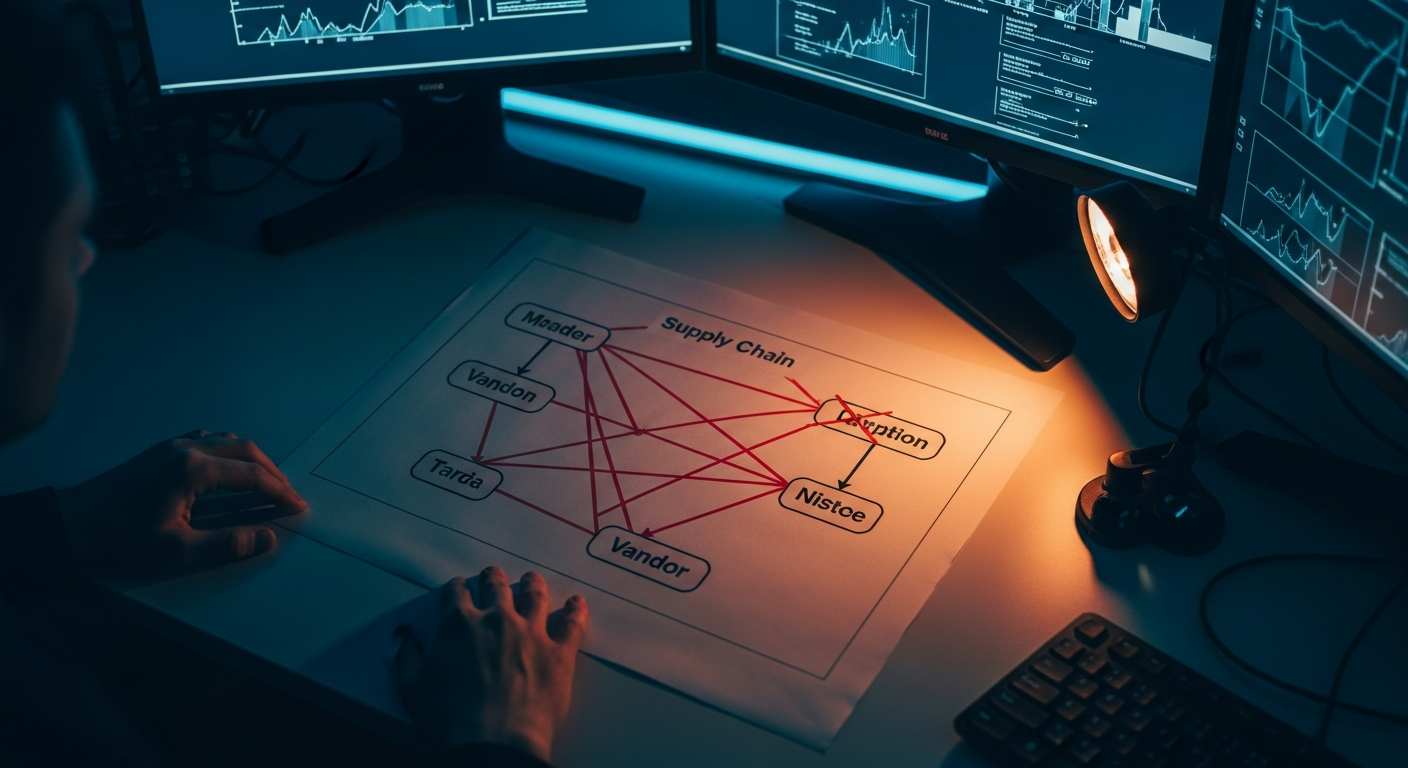
Most small and mid-sized businesses have quietly built their own supply chain over the last decade — they just do not think of it that way. Consider the average professional services firm in South Jersey or the Philadelphia metro. It likely depends on:
- A cloud-based practice management or ERP platform hosted by a third-party vendor
- A payroll processor with direct connections to financial systems
- A document management or electronic signature platform
- An IT provider with administrative access to core systems
- A client portal that external contacts use to exchange data
Each of those relationships is a trust boundary. If any one of those vendors is hit by a ransomware supply chain disruption, your operations do not need to be compromised directly for your business to grind to a halt. You are connected. You inherit a portion of their exposure — and their downtime.
The M&S incident made this visible at scale. The ransomware did not need to encrypt every server in every M&S building. It needed to disable the connective tissue between systems, and the business unraveled from there.
Operational Paralysis: The Cost No One Budgets For
When business owners think about cybersecurity risk, they tend to think about data theft: customer records, financial information, intellectual property. Those are legitimate concerns, and regulatory exposure around data breaches is real and growing.
But the cost of operational paralysis is often larger, faster, and harder to recover from than the breach itself. Walk through the cascade:
- A key vendor goes down Tuesday morning. Your team cannot access the platform you use to fulfill orders, manage client deliverables, or process transactions.
- You have no documented fallback — because the platform has always worked, so no one built one.
- Clients start calling. You have no estimated time to resolution because the vendor is not communicating clearly.
- By Thursday, a client has escalated internally and is asking to review your business continuity plan.
- By the following week, you are in a contract conversation you did not see coming.
None of that required a bad actor to touch your systems. You were collateral. And collateral damage in a ransomware supply chain disruption is not covered by most standard commercial insurance policies unless you have specifically negotiated cyber coverage that includes dependent business interruption clauses.
Most businesses have not done that. Most do not even know the question to ask. That gap — between the coverage companies assume they have and the coverage they actually carry — is one of the most consequential unaddressed risks in the market today.
Contractual and Operational Levers You Can Pull Right Now
There are concrete steps a business owner can take today, before any incident occurs. None require deep technical expertise. They require the same rigor you apply to any other vendor relationship.
Ask your vendors about their recovery time commitments. Any vendor holding systems you depend on should be able to tell you their recovery time objective — how quickly they commit to restoring service after an outage — and their recovery point objective, meaning how much data could be lost in a worst-case scenario. If a vendor cannot answer those questions clearly, that is your answer.
Review vendor contracts for business continuity language. Many standard contracts are silent on incident response obligations. Look for clauses that require the vendor to notify you within a defined timeframe if they experience a security event, and language that addresses service levels during a declared incident. If those clauses are absent, you can negotiate them — or factor their absence into your risk decisions.
Map your operational dependencies before someone else does it for you. Build a simple matrix: which business functions depend on which external systems, and what is the manual or alternative process if that system is unavailable? For most businesses, this exercise takes a few hours and surfaces dependencies no one had consciously documented.
Confirm your cyber insurance covers third-party interruption. Dependent business interruption coverage is a specific rider in most commercial cyber policies. Your broker should be able to confirm in one email whether you have it. If you do not, find out what it costs to add it.
Test your client communication plan. When a vendor goes down, your clients will want to hear from you quickly and clearly, with some indication of what you are doing. Having a templated message ready — not one written under pressure at 7 a.m. — is the difference between a client who stays and one who starts looking elsewhere.
What a Well-Run IT Environment Looks Like During a Ransomware Supply Chain Disruption
Businesses that came through incidents like the M&S disruption without major operational damage shared a few characteristics. They were not necessarily larger or better-funded. They were better prepared in specific, measurable ways.
A well-run environment maintains documented business continuity plans that are tested at least annually — not just written and filed. Those plans include vendor failure scenarios, not just internal hardware failures. They include defined communication trees and designated decision-makers who know what they are authorized to do without escalating every step.
A well-run environment also maintains layered authentication and access controls that contain how far damage can travel through a vendor relationship. If a third-party vendor is compromised, the blast radius into your environment is limited — because your systems require independent verification that the vendor’s systems cannot provide on their behalf.
At Xact IT, this is the kind of environment we have spent the last two decades building for our clients. The goal has never been to prevent every possible incident in the world around them — we cannot control what happens inside a vendor’s infrastructure. The goal is to ensure that when something happens out there, it does not become a crisis in here. You can learn more on our managed IT services page and our cybersecurity services page.
The result: zero client breaches across every client we have served since 2004. That is not a number we put forward lightly. It reflects decisions made consistently — in environment design, in access controls, in continuity planning — not occasionally.
How the NIST Framework Applies to Vendor Risk and Ransomware Supply Chain Disruption
One of the most useful tools for getting ahead of ransomware supply chain disruption risk is the NIST Cybersecurity Framework. Though it is often discussed in enterprise contexts, its five core functions — Identify, Protect, Detect, Respond, and Recover — map directly onto the vendor risk challenges that smaller businesses face.
The Identify function is where most businesses have the largest gap. You cannot manage what you have not mapped. Building that dependency matrix of vendors, platforms, and access relationships is the starting point the framework prescribes — and the step most often skipped because it feels administrative rather than technical.
The Protect function covers the controls that limit propagation: multi-factor authentication on every vendor-connected account, least-privilege access principles so a compromised vendor credential cannot move through your entire environment, and network segmentation that keeps vendor-integrated systems away from core operational data.
The Detect function is what allows your team — or your IT provider — to catch anomalous behavior early. In the M&S incident, a critical post-incident question is how long attacker access persisted before operational impact became visible. Early detection compresses that window significantly.
The Respond and Recover functions are where documented, tested plans earn their value. A business that has rehearsed its incident response will always outperform one responding to those procedures for the first time under pressure. This is not theoretical — it is consistently validated by post-incident analysis across industries.
Applying even a basic version of this framework to your vendor relationships — not just your internal infrastructure — is one of the highest-leverage investments you can make in resilience right now. Our team at Xact IT Cybersecurity Services helps clients build and validate exactly this kind of vendor-aware security posture.
The Conversation Worth Having Before the Incident
M&S will recover. They will update vendor contracts, rebuild systems, and eventually present the lessons learned at a conference. That story has a known arc.
The more useful takeaway for a business owner in New Jersey is simpler: a ransomware supply chain disruption does not need to touch your systems to shut your business down. Your vendors are your extended infrastructure. How well you understand, audit, and contractually protect those relationships is a business strategy question — not an IT question.
The companies that treat it as a business strategy question before something happens are the ones that come through intact. The ones that wait for the incident to prompt the conversation find that it arrives at the worst possible time, with the least possible leverage.
If you want to work through what your actual exposure looks like — which vendors represent real operational risk, what your current continuity plan covers, and where the gaps are — that is exactly the kind of conversation our team is built for. Book a Free Cybersecurity Strategy Call and we will work through it with you. No pressure, no obligation — just a direct conversation with people who have been doing this for 20 years.
Want a Walkthrough of Your Own Setup?
Twenty minutes on the phone with our team gets you specific recommendations you can use immediately — whether you hire us or not. No pitch, no pressure, just an honest read on where your business stands.